
Research:
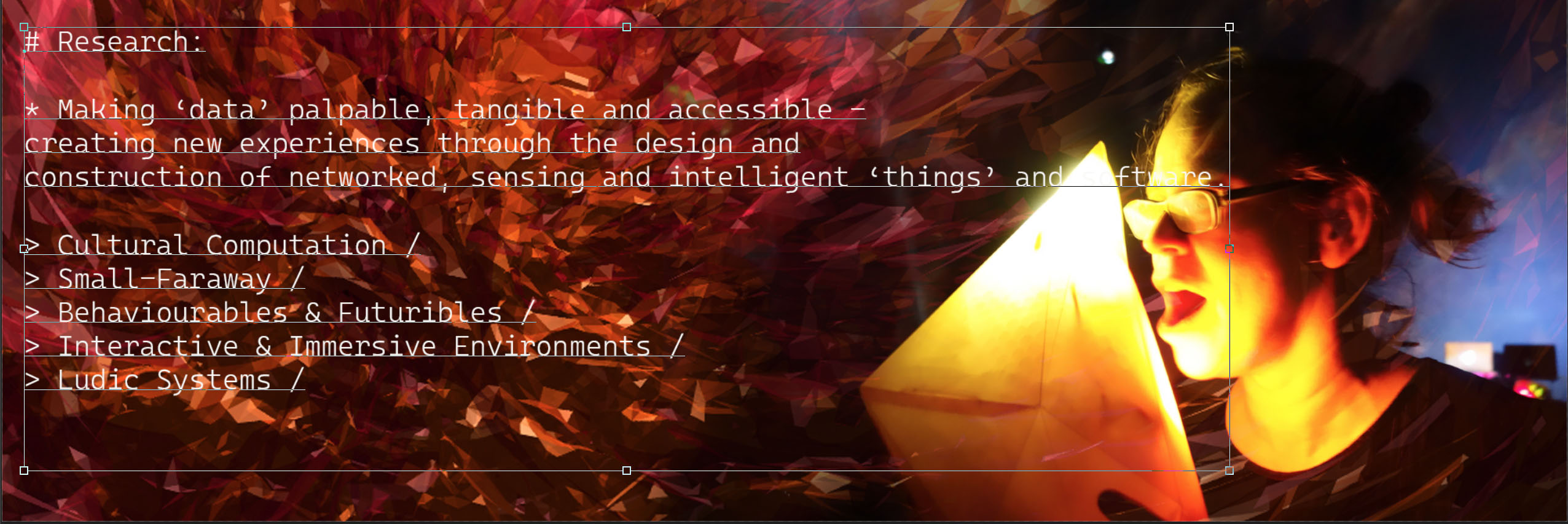
i-DAT’s underpinning research concerns making ‘data’ palpable, tangible and accessible. It involves creating new experiences through the design and construction of networked, sensing and intelligent ‘things’ and software.
Digital Practice is central to exploring the significance that data, its harvesting, processing and manifestation, can play in contemporary culture.
The research is collaborative and participatory at its core, engaging audiences and communities and cultivating a rich transdisciplinary approach through collaborations across the arts and sciences.
i-DAT’s research ethos and methodologies build on over twenty years of practice-based initiatives and have evolved from a series of ‘Operating Systems’ {

} and digital projects that have contributed to the strategic activities of not-for-profit, public, private and community sectors, including Arts Council England, Councils, UNESCO Biosphere, museums, festivals and Schools. i-DAT’s projects are delivered by the i-DAT Collective, a collaborative group of interdisciplinary artists, technologists and researchers. i-DAT’s audience engagement and metrics research builds on its previous real-world experience as an Arts Council England National Portfolio Organisation.
As part of its 20th anniversary Ctrl+Alt+Del i-DAT has synthesised a set of speculative research themes which will be the focus of its activity for the foreseeable future. These research themes will feed off and contribute to the recently funded research projects: South West Creative Technology Network (£6.5 million Research England), the Impact Lab (£6.4 million ERDF), eHealth (ERDF)

PGR: ResM/MPhil/PhD…
i-DAT’s research themes and projects provide a rich context for {Full Time or Part Time / local or remote} research students from a variety of disciplines, who can engage with these initiatives and build research activity grounded in their creative practice.
i-DAT’s core supervisory team has more than 70 PhD completions in a broad range of areas (design, software, interactive architecture, play, performance and robotics). i-DAT also supports Professor Roy Ascott’s Planetary Collegium.
Supervisory teams draw on collaborating research groups in the School of Art, Design & Architecture / Faculty of Arts, Humanities & Business, Sustainable Earth Institute, Cognition Institute. and eHealth.
Past, Present and Future i-DAT PhD’s can be found here ◯ ◯ ◯

i-DAT is the catalyst behind the CODEX international Postgraduate Research network, in collaboration with Jiangnan University, Nanjing University of the Arts and Soochow University in China.

Please contact a member of i-DAT to help develop your research proposal before submitting through University application process for ResM/MPhil/PhD, which can be found here:

Current Research Sessions for the i-DAT community. Schedules are managed by Rachel Horrell and Lana Pericic.
Research Themes:


Research Excellence Framework 2014 & 2021 Impact Case Studies, Unit of assessment 34/32: Art and Design: History, Practice and Theory.
Faculty of Arts, Humanities and Business studentships 2023: [CLOSED]
The full-time studentships are supported for three years and will start on 01 October 2023.
Building on our recent success in REF 2021, the Faculty of Arts, Humanities and Business at the University of Plymouth is making a strategic investment in eight funded PhD Studentships and invites talented applicants to submit outstanding PhD research proposals and applications connecting with all our disciplines across the arts, humanities, social sciences and practice as research.
The closing date for applications is 12 noon on 17 April 2023.
iMayflower Innovative Placements Scheme: [CLOSED] Postgraduate research projects – R&D Studentship award includes £3,000 Scholarship grant + £2,000 project budget. The iMayflower Masters R&D Studentship Scheme pairs talented new postgraduate design, art, heritage, digital and built environment students with innovative local companies to tackle a research project that contributes to the development of a new product, service or experience. The following projects are accepting applications until 30th July 2021: https://www.plymouth.ac.uk/business-partners/the-bridge/imayflower/innovative-placements
South West Creative Technology Network Fellowships: [CLOSED] Not strictly PGR funding but i-DAT is a partner in the South West Creative Technology Network (SWCTN), a £6.5 million project to expand the use of creative technologies across the South West of England. The network offers three one-year funded programmes around the themes of immersion, automation and data. The collaboration will invest in interdisciplinary fellowships and prototype production across three challenge areas: Immersion, Automation and Data. Our focus on creative technology brings together arts, design, computer sciences, engineering and business development to deliver new products and services. www swctn.org.uk
AHRC 3D3 Consortium: [CLOSED] i-DAT contributes to the Arts and Humanities Doctoral Training Centre in the Faculty of Art, Plymouth University (http://3d3research.co.uk/). In collaboration with University of the West of England (lead) and Falmouth University, Plymouth University has been successfully awarded a Centres for Doctoral Training (CDT). The studentship places will be advertised by the CDT on an annual basis, and studentship will be awarded on open competition. http://www.ahrc.ac.uk/Funding-Opportunities/Postgraduate-funding/Pages/Centres-for-Doctoral-Training.aspx
CogNovo: [CLOSED] i-DAT contributes to the Cognition Institute and a partner in the CogNovo Project is a multi-national doctoral training network that offers research training in Cognitive Innovation, both as a new field of scientific investigation and as a strategy for research and innovation. EU FP7 Marie Curie Initial Training Network (FP7-PEOPLE-2013-ITN-IDP 604764; 2013-17 €4.1m) “CogNovo: Cognitive Innovation”. Using creative technologies to promote behaviour change.
ALErT Project: [CLOSED] i-DAT is also involved in PhD supervision of the ALErT Project developing immersive geological simulations with Professor Iain Stewart on the EU FP7 Marie Curie Initial Training Network (FP7-PEOPLE-2013-ITN-IDP 607996; 2013-17).
The i-DAT Research Workshops build on the heritage of a series of practice based production workshops, seminars and symposia. These include: FulldomeUK, Skunk-Works, Balance Unbalance 2017, Transimage 2016, Scale Electric, Far Away So Close, AHO+Bartlett=i-DAT, VR/IVT Research Group, etc.

E/M/D/L / The Overview: Leonardo 50th Anniversary Celebration. Tate Collective TIWWA development workshop.
Workshop methodologies critically and playfully engage with themes, technologies and behaviours which frame the symptoms of individual and collective practices of the i-DAT research community.
From 2018 i-DAT will be delivering research workshops in collaboration with the Message and Design Knowledge research groups through the Design Area Research activities.
Research Environment:
i-DAT’s provides a highly connected research environment which incorporates its international transdisciplinary network, conferences, publications and funding opportunities.

*Ascott, R. “Behaviourables and Futuribles.” Control (London) 5 (1970). Reprinted in Theories and Documents of Contemporary Art, ed. Kristine Stiles and Peter Selz, 396 (Berkeley and Los Angeles: University of California Press, 1996). Reprinted in Telematic Embrace, Visionary Theories of art Technology and Consciousness by Roy Ascott, 157 (Berkeley and Los Angeles: University of California Press, 2003).
You must be logged in to post a comment.